
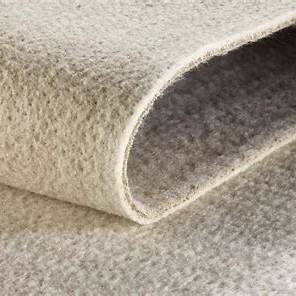
Geosynthetic Clay Liners (GCL)
GCL Bentonite Geosynthetic Clay Liner (3500–6000 g/m²)
Eurobent GCL, supplied and installed across Africa by Geosynthetics Africa. A reinforced bentonite mat combining two or more layers of geotextile with bentonite, a clay with strong swelling ability, needle-punched into a durable sealing layer that acts as a barrier to liquids, vapour and gases. Available in grades from 3500 to 6000 g/m² net bentonite.
Overview
Geosynthetics Africa supplies and installs the Eurobent GCL range across Africa, in grades from 3500 to 6000 g/m² net bentonite. Stocked in South Africa. One contract covers material, installation and CQA documentation.
What a GCL is and why it seals
A geosynthetic clay liner is a factory-made hydraulic barrier. Eurobent GCL combines two or more layers of geotextile with bentonite, a clay with excellent swelling ability. Woven and non-woven geotextiles are needle-punched together with the bentonite between them, producing a reinforced, strong sealing layer that acts as a barrier to liquids, vapour and gases.
The seal comes from the clay, not the fabric. Bentonite swells on contact with water. Held under the geotextiles and the cover soil above, the swollen clay forms a dense, low-permeability barrier. Because it swells rather than stretching, minor punctures and small installation defects close up instead of staying open - a geomembrane alone cannot do this. That matters most on sites where subgrade quality and construction supervision are variable.
Choosing a grade
All Eurobent grades share the same barrier mechanism. You select by bentonite mass, which is driven by hydraulic head, leachate chemistry and what the engineer or regulator requires.
Eurobent GCL CS adds a membrane layer to the standard mat - HDPE, LLDPE or PVC. Eurobent describes this as creating one durable barrier that offers double sealing, and dedicates the CS range mainly to the construction waterproofing market. Membrane thickness is available from 0.2 mm to 2.5 mm.
The practical difference is timing. A standard GCL needs to hydrate before it seals. GCL CS provides a barrier from the moment it's laid, which matters for below-ground structures, vertical faces, and anywhere liquid arrives before cover soil does
- MaterialSodium bentonite clay core; polypropylene (PP) woven and non-woven geotextile carriers
- StructureNeedle-punched reinforced GCL (woven top layer, non-woven bottom layer, encapsulated bentonite core)
- Colournatural white/cream
- StandardISO 9001 (Quality Management), ISO 14001 (Environmental Management), CE-certified GCL
- Roll Width5.10 m
- Roll Length40 m (204 m² per roll)
Typical Properties
| Property | Test Method | EB 3500 | EB 4000 | EB 4500 | EB 5000 | EB 6000 |
|---|---|---|---|---|---|---|
| Net bentonite content | EN 14196 | 3500 g/m2 | 4000 g/m2 | 4500 g/m2 | 5000 g/m2 | 6000 g/m2 |
| Total GCL mass | EN 14196 | 3800 g/m2 (+-10%) | 4300 g/m2 (+-10%) | 4800 g/m2 (+-10%) | 5300 g/m2 (+-10% | 6300 g/m2 (+-10%) |
| Thickness | EN ISO 9863-1/-2 | 5.8mm (+-1mm) | 6.6mm (+-1mm) | 6.8mm (+-1mm) | 7.4mm (+-1mm) | 7.8mm (+-1mm) |
| Index Flux | ASTM D5887 | <=5.0x10⁻⁹ m3/m2/s | <=5.0x10⁻⁹ m3/m2/s | <=5.0x10⁻⁹ m3/m2/s | <=5.0x10⁻⁹ m3/m2/s | <=5.0x10⁻⁹ m3/m2/s |
| Permeability | ASTM D5887 | <=5.0x10⁻¹¹ m/s | <=5.0x10⁻¹¹ m/s | <=5.0x10⁻¹¹ m/s | <=5.0x10⁻¹¹ m/s | <=5.0x10⁻¹¹ m/s |
| Tensile Strength MD | EN ISO 10319 | >=10.4 kN/m | >=10.4 kN/m | >=10.4 kN/m | >=10.4 kN/m (-1kN/m) | >=10.4 kN/m (-10%) |
| Tensile Strength CMD | EN ISO 10319 | >=8.5 kN/m | >=8.5 kN/m | >=8.5 kN/m | >=8.5 kN/m (-0.8kN/m) | >=8.5 kN/m (-10%) |
| CBR Puncture Strength | EN ISO 12236 | >=1.8 kN | >=1.8 kN | >=1.8 kN | >=1.8 kN (-0.18kN) | >=1.8 kN (-10%) |
| Peel Strength | ASTM D6496 | >=60 N/10cm | >=60 N/10cm | >=60 N/10cm | >=60 N/10cm (-6N/10cm) | >=60 N/10cm (-10%) |
| Montmorillonite | CUR 33 | >=75% | >=75% | >=75% | >=75% | >=75% |
| Swell Index | ASTM D5890 | >=24 ml/2g | >=24 ml/2g | >=24 ml/2g | >=24 ml/2g | >=24 ml/2g |
| Roll width | - | 5.1m | 5.1m | 5.1m | 5.1m | 5.1m |
| Roll length | - | 40m (+-1%) | 40m (+-1%) | 40m (+-1%) | 40m (+-1%) | 35m (+-1%) |
| Roll area | - | 204m2 | 204m2 | 204m2 | 204m2 | 178.5m2 |
Note: The above specifications represent the product family properties. Please refer to the product datasheet for individual SKU values.
Typical Applications
View all applicationsLandfill Base Liners and Closure Caps
Eurobent reinforced GCL satisfies EN 13493 for solid waste storage and disposal sites. As a base liner component, GCL provides the low-permeability clay barrier required by waste disposal regulations without clay borrow dependency or compaction programme risk. As a closure cap component, GCL provides the moisture barrier preventing rainwater infiltration into waste cells. CE marked. ITR documentation supplied with every roll for Environment Agency, DEA, and regulatory authority compliance on landfill projects across Africa.
Dams, Reservoirs and Water Retention
Eurobent reinforced GCL is compliant with EN 13361 for reservoirs and dams. Installed on the upstream face of earth embankment dams and in reservoir base and side slope lining systems, GCL provides a permanent self-sealing hydraulic barrier replacing compacted clay puddle core or conventional clay lining. Used for irrigation reservoirs, potable water storage, industrial water supply dams, and agricultural water harvesting structures across Africa where compacted clay is unavailable locally or programme time is constrained
Canal Lining and Water Distribution
Eurobent reinforced GCL is compliant with EN 13362 for canal construction. Installed beneath concrete or aggregate canal lining, or used as a standalone barrier in low-velocity irrigation canals, GCL prevents seepage losses that account for 30 to 50% of delivered water in unlined canal systems. GCL canal lining is faster and more cost-effective than conventional concrete lining on canals with active clay subgrades or differential settlement risk - a common condition on African irrigation infrastructure.
Secondary Containment and Environmental Protection
Eurobent reinforced GCL compliant with EN 13492 for liquid waste disposal sites and secondary containment. Specified beneath fuel storage facilities, chemical storage bunds, transformer oil containment, and industrial process areas where secondary containment is required by regulation. The self-sealing bentonite provides redundancy that rigid concrete bund liners cannot match. Rapidly deployable on existing industrial sites with minimal civil disruption - a critical advantage on operational mine sites and industrial facilities.
Infrastructure Waterproofing and Transportation
Eurobent reinforced GCL is compliant with EN 15382 for transportation infrastructure. Used beneath road and railway embankments over contaminated ground to prevent upward migration of contaminants, as environmental protection under airports and logistics facilities on sensitive groundwater zones, and as a waterproofing barrier in below-ground civil structures. The self-sealing bentonite layer provides long-term barrier performance that synthetic membranes alone cannot guarantee under differential settlement conditions common in African road and rail embankment construction.
Compatible Systems
View all systemsEurobent 3500 - Standard Grade - Secondary Containment and Low to Medium Head Applications
Eurobent 3500 is the entry grade with 3500 g/m2 net bentonite content and 5.8mm total thickness. Carrier layer 100 g/m2 PP woven, cover layer 200 g/m2 PP nonwoven. Permeability less than or equal to 5.0 x 10⁻¹¹ m/s. Tensile strength MD 10.4 kN/m, CMD 8.5 kN/m. Peel strength 60 N/10cm. Roll format 5.1m x 40m - 204m2 per roll. Suited to secondary containment, stormwater retention ponds, and applications where a moderate bentonite mass satisfies the engineer or regulatory requirement. CE marked. EN 13361 and EN 13492 compliant.
Eurobent 4000 - Mid-Range Grade - Water Containment and Environmental Lining
Eurobent 4000 provides 4000 g/m2 net bentonite content and 6.6mm total thickness. Same permeability, tensile, CBR, and peel performance as all Eurobent grades. Roll format 5.1m x 40m - 204m2 per roll. Suited to irrigation reservoir lining, stormwater management ponds, environmental protection liners under infrastructure, and secondary containment for fuel and chemical storage. CE marked. Full EN harmonised technical specification compliance.
Eurobent 4500 - Mid-Heavy Grade - Mining Containment and Dam Applications
Eurobent 4500 provides 4500 g/m2 net bentonite content and 6.8mm total thickness. Standard mid-heavy specification for mining containment structures, tailings facility perimeter berms, small dam and weir sealing, canal lining, and applications requiring increased bentonite mass for higher hydraulic head or more chemically aggressive leachate. Roll format 5.1m x 40m - 204m2 per roll. CE marked. 25-year material warranty.
Eurobent 5000 - Heavy Grade - Tailings, Landfill and High-Head Containment
Eurobent 5000 is the primary specification grade for demanding African containment projects. 5000 g/m2 net bentonite, 7.4mm thickness, total GCL mass 5300 g/m2. Tensile MD 10.4 kN/m (-1kN/m), CMD 8.5 kN/m (-0.8kN/m). CBR puncture 1.8 kN (-0.18kN). Peel strength 60 N/10cm (-6N/10cm). Roll format 5.1m x 40m - 204m2 per roll. Specified for tailings storage facilities, landfill base liners, high-head reservoirs and dams, and primary containment for toxic and hazardous liquid waste. The most widely specified Eurobent grade on African mining and environmental projects. CE marked. 25-year warranty.
Eurobent 6000 - Maximum Bentonite Grade - Highest Containment Requirements
Eurobent 6000 is the highest bentonite content standard grade at 6000 g/m2 net bentonite and 7.8mm total thickness. Total GCL mass 6300 g/m2 (+-10%). Tensile MD 10.4 kN/m (-10%), CMD 8.5 kN/m (-10%). CBR puncture 1.8 kN (-10%). Peel strength 60 N/10cm (-10%). Roll format 5.1m x 35m - 178.5m2 per roll. Specified where maximum bentonite mass is required by the engineer or regulatory authority - primary liner systems for hazardous waste containment, high-head tailings facilities, and projects requiring maximum specification GCL as the secondary barrier behind a geomembrane primary liner. CE marked. 25-year warranty.
Installation Guidance
Standard Method Statement
Eurobent GCL installation requires specific competence and must not be treated as a general civil works task. The two most common causes of GCL liner breach on African containment projects are premature hydration without confining stress and inadequate seam overlap. Both are preventable with correct procedure and competent supervision. Geosynthetics Africa provides experienced IAGI member installation teams and site-specific method statements for every installation project.
1. Subgrade Preparation - Strip and compact the subgrade to the engineer-approved formation level. Remove all sharp rocks, organic matter, and objects larger than 50mm. Compact to minimum 90% Proctor density - the surface must be smooth and free of ruts deeper than 25mm. Proof-roll and repair any weak or soft areas. Obtain written engineer approval of the subgrade before any GCL is deployed.
2. Roll Handling and Delivery Inspection - Visually inspect each roll when unloaded to confirm packaging and material integrity. Minor packaging tears must be repaired with moisture-resistant tape before storage. Rolls with visible material damage must be marked, set aside, and examined before deployment. Do not remove the UV-resistant plastic sleeve until immediately before deployment. Insert a steel core through the roll during unloading to prevent bending. Do not stack rolls more than 4 high. Store on pallets - not directly on ground. Cover with tarpaulin if stored outdoors.
3. Deployment and Panel Orientation - Confirm the correct GCL orientation with the project engineer before deployment - woven carrier layer down, nonwoven cover layer up, unless otherwise specified. Unroll from the bottom rather than pulling the flap from the top. Do not allow rolls to unroll freely down slopes - control the unrolling rate. Place longitudinal seams parallel to the slope direction. End seams must be located at minimum 1m from the toe and crest of slopes steeper than 4H:1V. Place panels flat without folds - particularly at uncovered edges. Equipment must not move directly on unprotected GCL - lightweight ATVs with maximum 21.5 kPa bearing pressure only.
4. Seam Overlaps and Bentonite Powder Application - Overlap all panel edges by minimum 300mm - use the overlap guideline and match-line imprinted on both panel edges to confirm accuracy. Apply bentonite powder from the supplied 20kg bag uniformly across the full 300mm overlap width before placing the overlapping panel. One 20kg bag is supplied per roll for standard overlaps - one bag per three rolls for prefabricated overlap rolls. Do not install panels in standing water or during rain. Seam overlap dimensions and bentonite powder application must be verified and recorded by the CQA inspector for each seam.
5. Anchor Trench Construction - Excavate anchor trenches at all perimeter edges, slope crests, and toes to the dimensions specified by the project engineer. Fold the GCL edge into the trench, backfill with approved material, and compact. The anchor trench is a structural element of the liner system - inadequate anchorage allows liner uplift under hydraulic head and is a primary cause of liner system failure on slopes and embankments. All anchor trench construction must be documented in the CQA record with dimensions and photographs.
6. Cover Placement and Hydration - Cover soil must be placed over the GCL immediately after installation - at the end of every working day at minimum. Place cover soil maintaining minimum 300mm of cover between equipment tyres or tracks and the GCL at all times - 600mm minimum in high-traffic areas and roadway zones. Move cover soil upslope rather than downslope to minimise tensile forces on the liner. Hydration under confining stress from cover soil is normally accomplished naturally by rainfall and moisture absorption from the soil. Manual hydration by flooding or irrigation may be required in dry climates or where non-aqueous liquid containment is the primary function.
Quality Assurance & Testing
Field QA/QC Checklist
- Storage & Handling: Rolls stored and handled to ASTM D5888: off the ground, fully covered and kept dry; any rolls hydrated before installation rejected or replaced.
- Material Conformance: Roll certificates checked against GRI-GCL3: bentonite mass per area, swell index, fluid loss, peel strength and permeability.
- Subgrade Acceptance: Subgrade smooth, firm and free of stones and standing water before placing the GCL.
- Placement & Overlaps: GCL placed to ASTM D6102 with the correct side up, panel overlaps and supplementary bentonite at overlaps to the manufacturer's requirement.
- Cover Placement: Covered with the overlying geomembrane or soil the same day; no equipment directly on the GCL; damaged areas patched with an oversized overlapping piece.
Manufacturing Standards
- GRI-GCL3 GCL specification
- ASTM D5888 storage and handling
- ASTM D6102 installation guide
- Manufacturer QC certificates per roll
- ISO 9001 (Quality Management), ISO 14001 (Environmental Management), CE-certified GCL
Documents
Product Selection Guide
Compare performance properties across the entire category hierarchy before specifying.
Installation & Method Statement
Standard deployment procedures, installation specifications, and field application method statements.
QA/QC Site Checklist
Field quality control procedures, inspection checklists, and testing standards to verify installation integrity.
Technical Data Sheet (TDS)
Guaranteed minimum average roll values (MARV) and material testing properties.
Chemical Resistance / Accessories Guide
Chemical compatibility matrix and list of auxiliary materials needed for installation.
Projects Using GCL Bentonite Geosynthetic Clay Liner (3500–6000 g/m²)
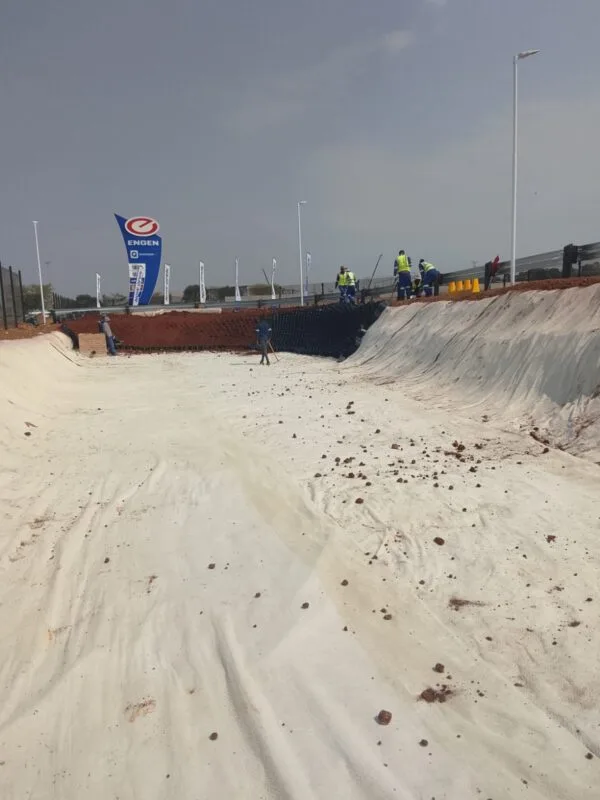
Supply and installation of an EB4000 geosynthetic clay liner and GS150 geocell system for a 1,300 m² stormwater attenuation pond at a fuel-depot expansion in South Africa.
Submit your BOQ.
Get a quote – not just a price.
Upload your BOQ or speak to our technical team for expert recommendations and support.